
Can the ATO Write Off Your Tax Debt? What Actually Happens
By Doug Constable · 23 October 2026
Can the ATO Write Off Your Tax Debt? What Actually Happens
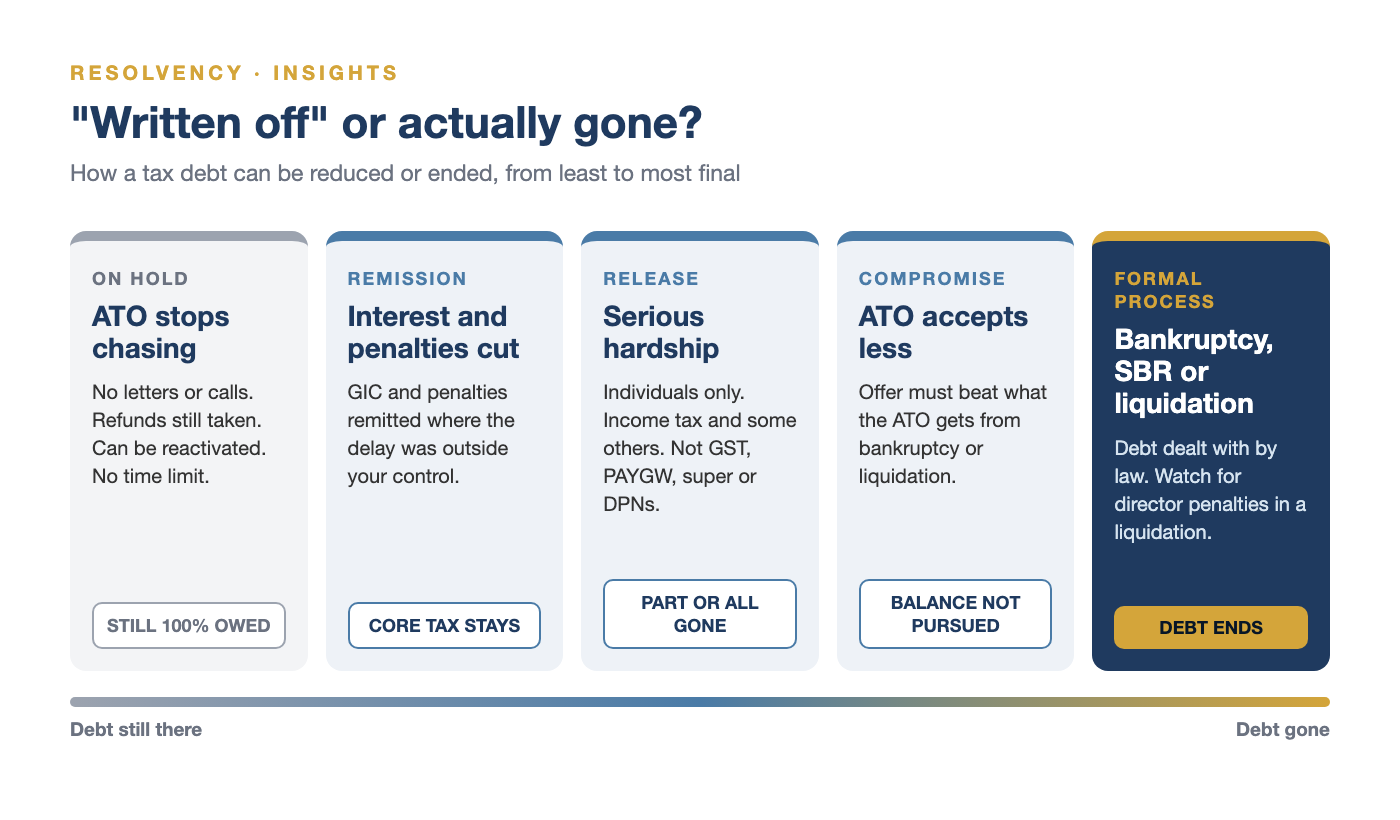
Rarely, and almost never the way people hope. The ATO collects tax on behalf of the Commonwealth, and for most debts it has no power to simply wipe them. When people say the ATO "wrote off" their debt, what usually happened is the ATO put it on hold: it stopped chasing, but the debt is still owed and it will take any future refund to pay it down. The ATO can permanently cut a debt in three narrow ways: remitting interest and penalties, releasing an individual from certain taxes on serious hardship grounds, and accepting a compromise. Outside the ATO, a debt can also end through bankruptcy, Small Business Restructuring or liquidation.
Which of those is open to you depends on two things: whose debt it is (yours or your company's) and what type of tax it is. Get those two answers first and most of the confusion clears.
The release power sits in section 340-5 of Schedule 1 to the Taxation Administration Act 1953 (Cth). Interest remission sits in section 8AAG of the same Act, and the ATO's approach to compromise is set out in Practice Statement PS LA 2011/3.
"Written off" usually means "on hold"
The ATO will put a debt on hold when it decides chasing it is not worth the cost right now: the amount is small, or you have no income or assets to take it from. You stop getting letters and calls. That feels like the debt has gone away. It hasn't.
- It is still legally owed. The ATO's own words are that a debt on hold "remains due and legally payable".
- Refunds get taken. Any tax refund or credit you become entitled to is used to pay it down. This is called offsetting, and it is how many people discover an old debt years later.
- It can come back. If your income or assets improve, the ATO can take the debt off hold and start collecting again.
- There is no time limit. Tax debts don't expire after six years the way many other debts do.
- It is now showing up again. The ATO has been adding debts on hold back into account balances, so a balance that read zero can suddenly show an amount owing.
There is one exception in progress. The government announced in the 2024-25 Budget that the ATO would get discretion not to offset refunds against some debts put on hold before 1 January 2017, for individuals, small businesses and not-for-profits. As at the ATO's last update (April 2026), that measure is not yet law. In the meantime the ATO is not offsetting those pre-2017 debts or adding them to account balances. Debts put on hold from 2017 onwards are not covered at all.
Three ways the ATO can genuinely reduce a debt
1. Remitting interest and penalties. The general interest charge (GIC) compounds daily and can make up a large share of an older debt. The ATO can remit some or all of it, and some or all of a penalty, where the delay or failure was outside your control or keeping the charge would be unfair. This is the most realistic win for most people. It doesn't touch the core tax, but it can take a real bite out of the total.
2. Release from the debt (individuals only). The ATO can permanently release an individual, or the trustee of a deceased estate, from some tax debts where paying them would cause serious hardship. Serious hardship means paying would leave your household without the basics: food, accommodation, clothing, medical care, education. Companies, trusts and partnerships can't apply. And only some taxes qualify, which is where most applications fall over. More on how release is assessed in ATO Release of Debt: When It Applies.
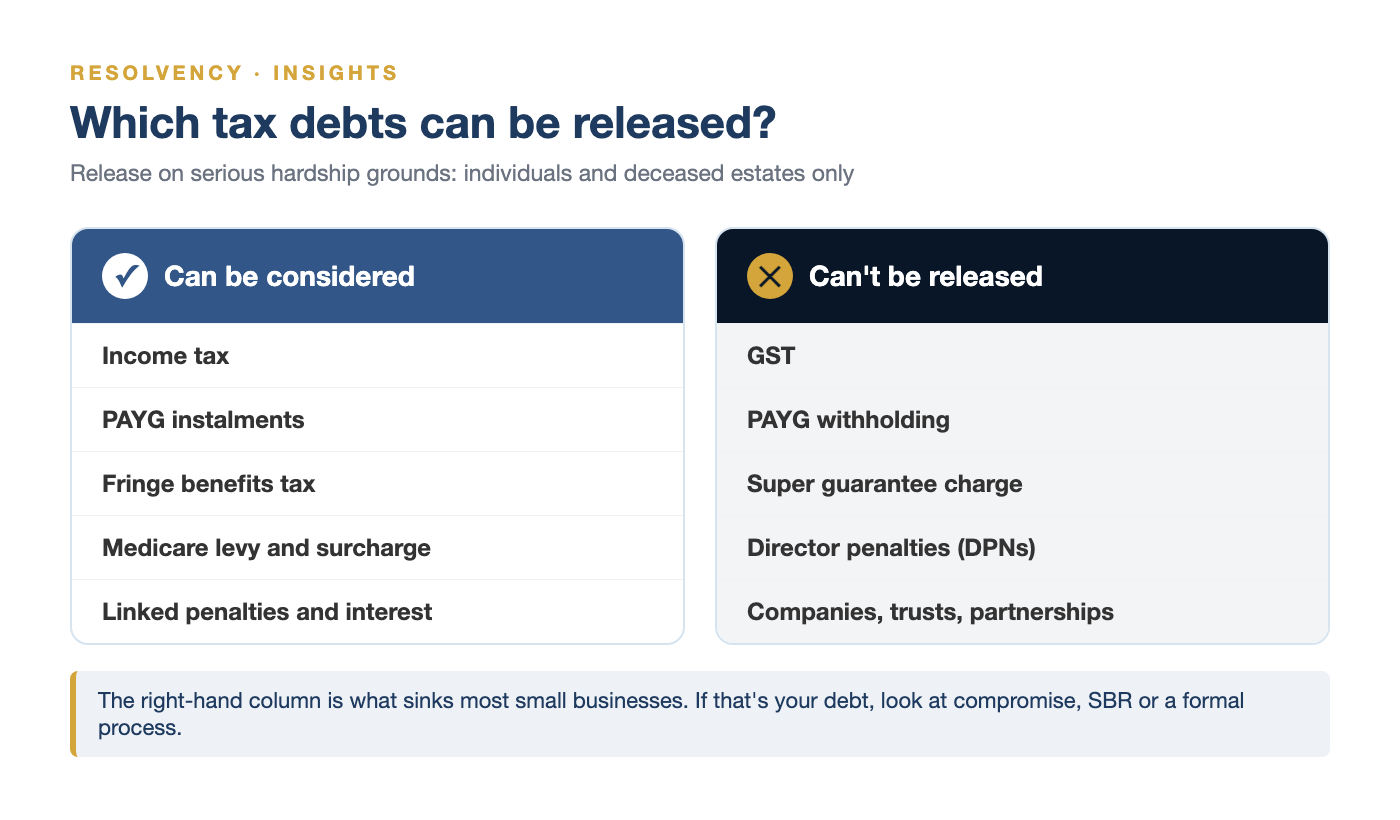
| Can be considered for release | Can't be released |
|---|---|
| Income tax | GST |
| PAYG instalments | PAYG withholding |
| Fringe benefits tax (and FBT instalments) | Super guarantee charge |
| Medicare levy and Medicare levy surcharge | Director penalties (DPNs) |
| Withholding tax on dividends, interest and royalties | Excess contributions tax and Division 293 tax |
| Some penalties and interest linked to the above |
Look at the right-hand column. GST, PAYG withholding, super and director penalties are exactly the debts that sink small businesses and their directors. If that is what you owe, release is off the table and the conversation moves elsewhere.
3. A compromise. The ATO can agree to accept less than the full amount on an undisputed debt and not pursue the balance. It only does this when your offer clearly beats what it would recover by bankrupting you or winding up your company, your lodgements are up to date, and the numbers prove it. It is narrow, it is evidence-heavy, and applying has consequences of its own. The full picture is in ATO Compromise: Settle Tax Debt for Less.
Whose debt is it? That decides the real options
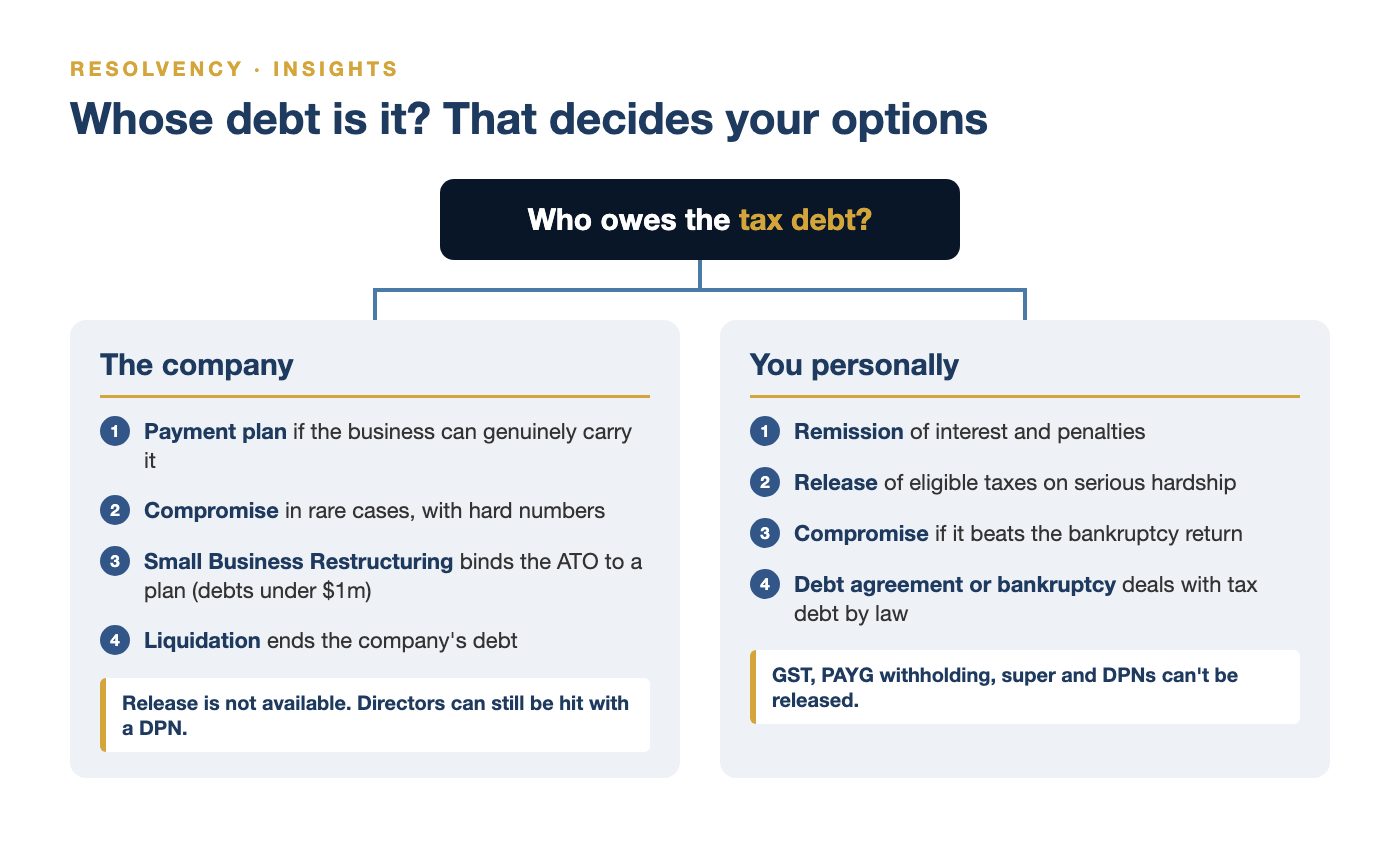
If the debt is your company's, release is not available, and a stand-alone compromise is rare. The routes that actually reduce company tax debt are formal:
- Small Business Restructuring (SBR). Under Part 5.3B of the Corporations Act 2001 (Cth), an eligible company with liabilities under $1 million can put a plan to all its creditors, the ATO included. If the majority by value accepts, the ATO is bound by the plan and the rest of the debt goes. Lodgements and employee entitlements have to be up to date to get in the door. See Small Business Restructuring Explained.
- Liquidation. When a company is wound up, its tax debt goes with it. But the ATO can make directors personally liable for the company's unpaid PAYG withholding, GST and super through a Director Penalty Notice. Liquidation ends the company's debt; it does not end yours. See Director Penalty Notices Explained.
If the debt is yours personally, start with remission, then check whether any of it is release-eligible, then whether a compromise stacks up. If none of those work and the debt is beyond you, a debt agreement under Part IX of the Bankruptcy Act 1966 (Cth) or bankruptcy itself will deal with tax debts along with everything else. Tax debts are provable in bankruptcy and are released on discharge. That is the one path that does reliably make ATO debt disappear, and it comes at a real cost.
What to do before anything else
- Get your lodgements up to date. Every option above (remission, release, compromise, SBR, even a sensible payment plan) depends on it. Outstanding BAS also decides whether a director penalty is lockdown or not.
- Find out exactly what you owe and what type it is. Income tax, GST, PAYG withholding and super are treated completely differently.
- Check for debts on hold. Log into ATO online services or ask your accountant. Better to know now than when your refund disappears.
- Don't sign up to a payment plan you can't keep. A defaulted plan leaves you worse off. See Why ATO Payment Plans Can Backfire.
- Don't wait for the ATO to decide for you. Every option narrows once a DPN, garnishee notice or wind-up application arrives.
Common questions
Can the ATO forgive tax debt?
Only in limited cases. It can release individuals from certain tax debts on serious hardship grounds, remit interest and penalties, or accept a compromise. It can't forgive GST, PAYG withholding, super guarantee charge or director penalties through release, and companies can't apply for release at all.
Does ATO debt expire after a certain number of years?
No. Unlike most private debts, tax debts are not statute-barred after six years. A debt the ATO stopped chasing ten years ago can still be offset against a refund or brought back into collection.
What does it mean if the ATO put my debt on hold?
The ATO has decided not to chase it for now, usually because it isn't cost effective. The debt is still legally owed, any refunds will be used to reduce it, and the ATO can take it off hold if your situation improves.
Can a company have its tax debt released?
No. Release is only available to individuals and trustees of deceased estates. A company's tax debt can be reduced through a compromise, a Small Business Restructuring plan, or ended by liquidation, but directors may still face personal liability through a Director Penalty Notice.
Does bankruptcy wipe ATO debt?
Generally yes. Tax debts, including director penalties, are provable in bankruptcy and are released when you are discharged, usually after three years. It is a serious step with its own consequences, so it should be weighed against every other option first.
Where I fit
I'm not a tax agent, a lawyer or a liquidator. I coordinate. I work out whose debt it is, what type of tax it is, and which of these options is genuinely open to you, then connect you with the right practitioner to run it, whether that's a remission request, a compromise, an SBR plan or a wind-up. I work for you, not the ATO, and I've been doing this since 1988.
If the ATO is chasing you, or an old debt has turned up out of nowhere, book a phone or video time at resolvency.com.au/book or call 0457 099 099.
General information only — not financial, legal or tax advice. Everyone's position is different, so get advice specific to yours before you act.
Related service: ATO Debt & Payment Pressure — see how I can help.
Facing this yourself?
Start with the free guide, or talk to us directly.
Private and confidential.