
One in Four Company Collapses Is Now a Builder: Australia's Construction Insolvency Crisis
By Doug Constable · 12 September 2026
One in Four Company Collapses Is Now a Builder: Australia's Construction Insolvency Crisis
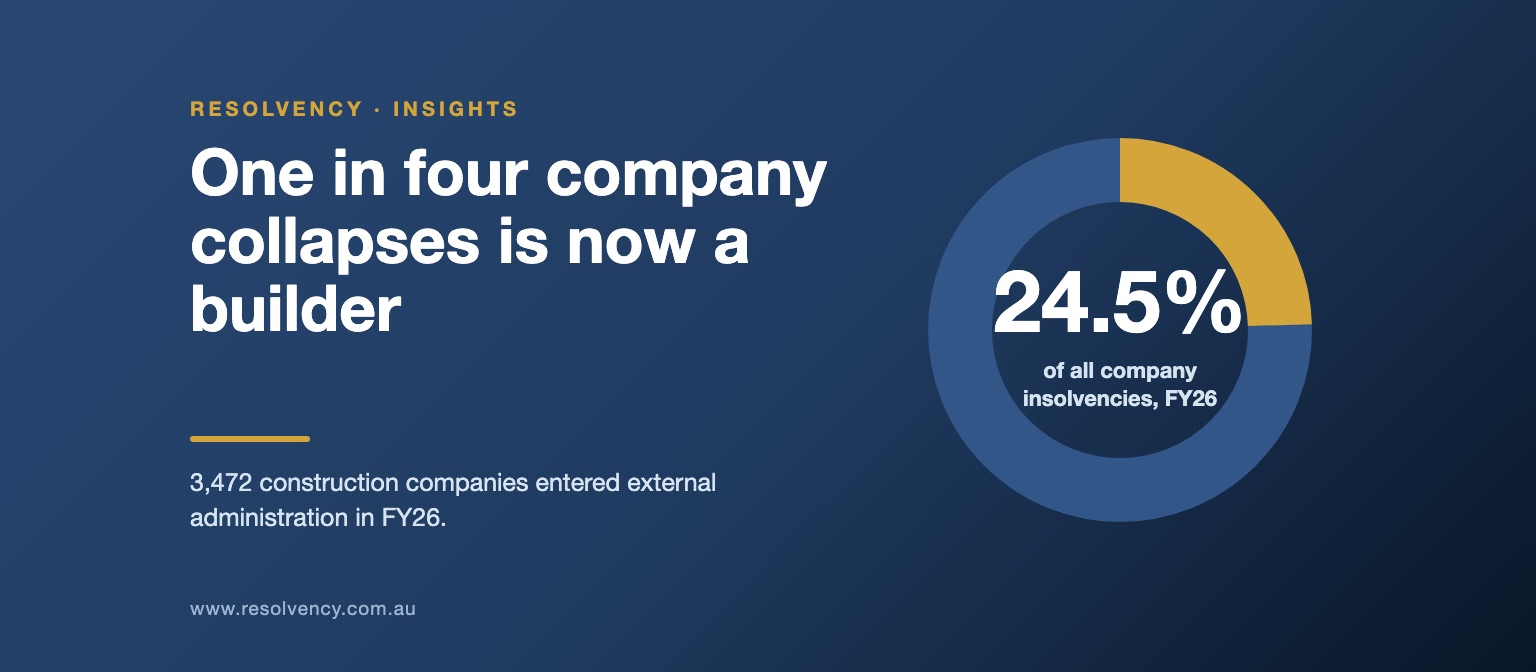
3,472 construction companies entered external administration in the year to June 2026 — 24.5% of every company insolvency in the country, in one industry. The structural cause is a fixed-price contract signed months before a slab is poured, honoured under whatever material costs, labour rates and interest rates exist by the time the job actually runs. When those move against the builder — as they have for several years straight — the company absorbs the difference until it can't. If you're a director, subcontractor or supplier in this industry, the number that matters isn't the headline collapse count. It's whether your own contracts carry the same exposure.
The biggest name in the headlines this month is Bathla Group — a Sydney developer owing roughly $3.4 billion to private lenders, with around 2,000 apartments mid-construction and a further 14,000-home pipeline now in doubt. It's the largest recent example of an industry-wide pattern, not an isolated failure.
A company is insolvent under section 95A of the Corporations Act 2001 (Cth) if it cannot pay its debts as and when they fall due — a cash flow test, not a balance sheet one. A director's duty to prevent the company trading while insolvent is set out in section 588G.
Why construction fails differently to other industries
Most industries can pass on a cost increase to the next sale. A construction contract locks the sale price in before costs are known. That single structural difference explains why this sector carries a level of financial distress well above every other industry in the country, year after year:
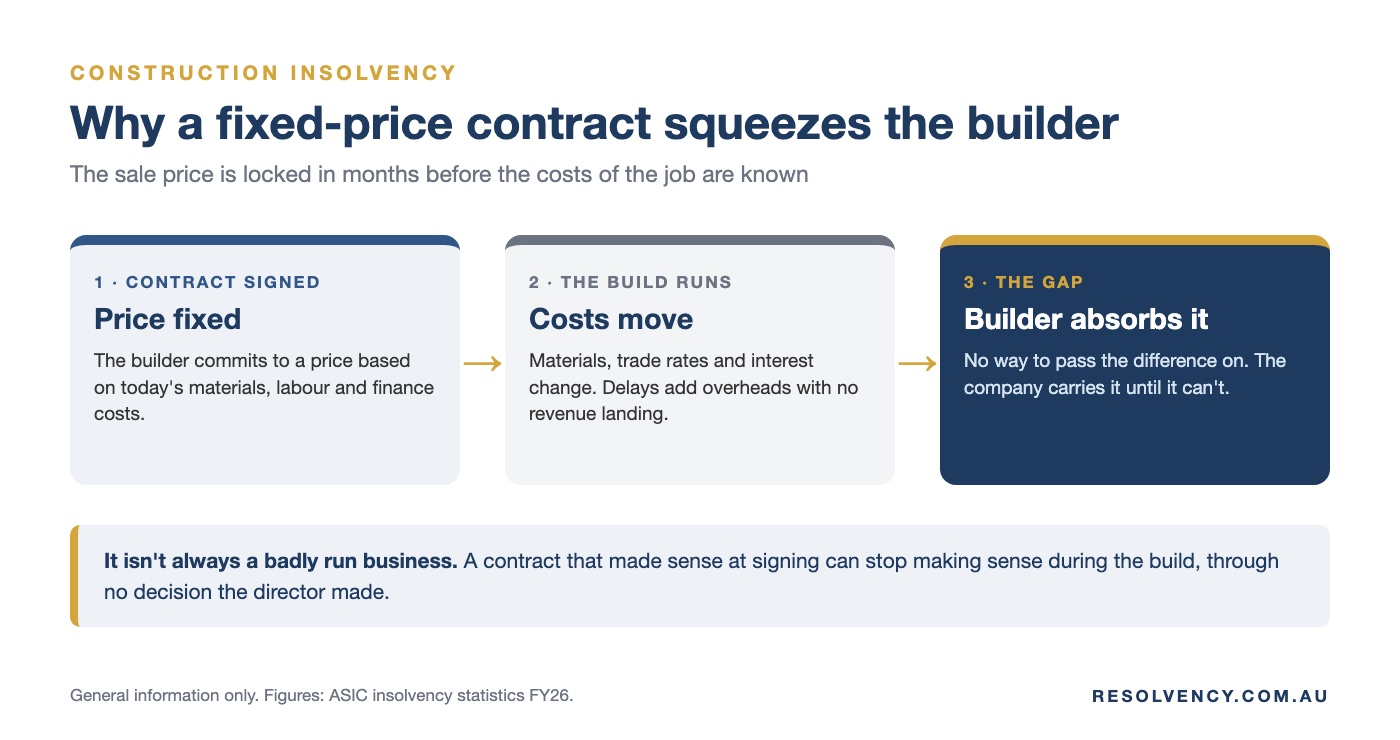
- Fixed-price risk sits entirely with the builder. Material costs, trade labour rates and finance costs can all move between contract signing and practical completion — sometimes by a wide margin — and the builder absorbs it.
- Supply chain delays compound it. A delayed job is a job still carrying overheads with no revenue landing, on top of a margin that was already thin.
- The insolvency isn't always a sign of a badly run business. A contract that made sense at signing can stop making sense within the build period, through no decision the director made.
Encouragingly, the raw number of construction insolvencies ticked down slightly in FY26 for the first time in five years. That's a data point, not a turnaround — the sector's share of national insolvencies is still disproportionate, and large collapses like Bathla continue to land.
What this means if you're inside the industry right now
For a director, the exposure isn't just the company. Section 588G creates personal liability for debts incurred while trading insolvent, and directors in this sector are more likely than most to be carrying personal guarantees on equipment finance, trade accounts or a construction loan. For a subcontractor, a head contractor's collapse can turn a completed job into an unrecoverable debt overnight — retention money and final claims rank behind secured creditors in almost every liquidation.
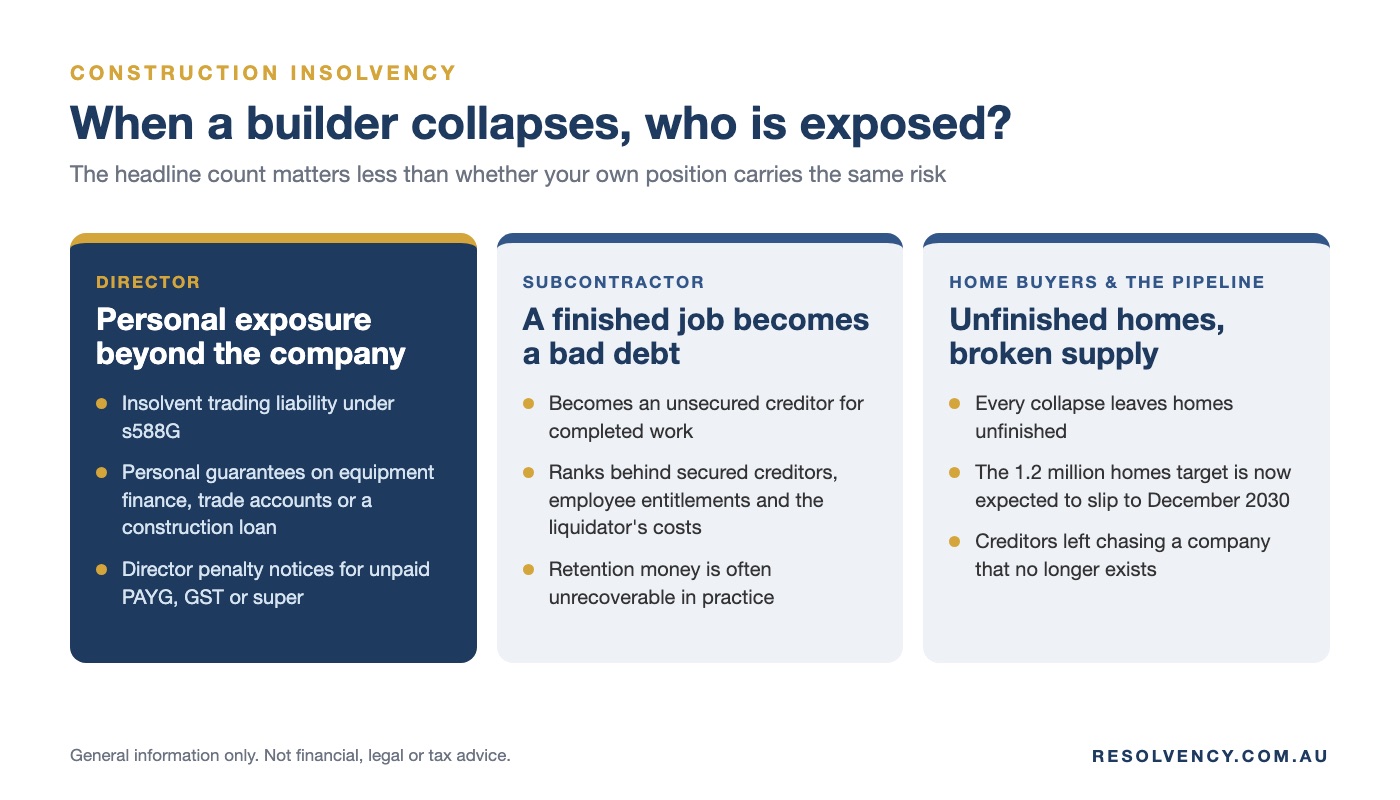
The federal target of 1.2 million new homes by 2029 is now expected to slip to December 2030, and construction insolvencies are a direct contributor — every collapsed builder means unfinished homes, a broken pipeline, and creditors left chasing a company that no longer exists.
Common questions
Why does construction have so many more insolvencies than other industries?
Fixed-price contracts are signed before material costs, labour rates and finance costs are known at the time the job actually runs. When those costs move against the builder — which they have across multiple years of high inflation and rate rises — there is no mechanism in a fixed-price contract to pass the difference on. The company absorbs it until it can't.
Does a construction company collapsing make its director personally bankrupt?
Not automatically. Liquidation ends the company; it doesn't of itself make a director bankrupt. Personal exposure comes through separate mechanisms — personal guarantees on finance or leases, a director penalty notice for unpaid PAYG, GST or super, or an insolvent trading claim under section 588G. Many directors carry more than one of these without realising it.
What happens to a subcontractor when the head contractor collapses?
The subcontractor becomes an unsecured creditor for whatever is owed on completed work, and ranks behind secured creditors, employee entitlements and the liquidator's own costs in the distribution. Retention money held by the head contractor is frequently unrecoverable in practice, even where it's contractually owed.
Is safe harbour available to a construction company in financial difficulty?
It can be, if the conditions are met — lodgements current, employee entitlements paid, and a genuine, properly-advised turnaround plan in place. In practice many construction companies reach financial difficulty already behind on one of those conditions, which is why Small Business Restructuring is often the more accessible option for owner-operator builders. See What Is Small Business Restructuring (SBR) and How Does It Work?
Is the construction insolvency rate actually improving?
Marginally. FY26 was the first year in five where the raw count of construction insolvencies fell rather than rose. But the sector's 24.5% share of all national company insolvencies remains far above any other industry, and large collapses — Bathla among them — are still occurring. One year of a smaller increase is not evidence the structural problem is fixed.
Where I fit
I've run a business through fixed costs and a moving world myself. I'm not a liquidator or a trustee — I look at your actual position: cash flow, contracts on the books, what's fixed and what isn't, and which personal exposure already exists. Then I coordinate the right path — a payment arrangement, Small Business Restructuring, or an orderly wind-up — before a wind-up notice removes the choice.
If you're a director in this industry watching the headlines and recognising your own numbers, book a phone or video time at resolvency.com.au/book or call 0457 099 099.
General information only — not financial, legal or tax advice. Everyone's position is different, so get advice specific to yours before you act.
Related service: Restructure & Trade On — see how I can help.
Facing this yourself?
Start with the free guide, or talk to us directly.
Private and confidential.